Back to e-zine
|
|||||||||||||||||||||||||||||
 |
search of PURE Gold The research uncovered a litany of social, environmental, livelihoods, economic and human rights issues that faced the jewellery world. Here is an industry as ancient as the hills, full of creativity and promise and yet with its head so far up its own arse on social and environmental critic it’s swinging on its own tonsils. My sense of outrage as a committed campaigner for the poor and half committed environmentalist (I suffer from the same sense of dislocation from my environment that all westerns have) as well as a man who runs a jewellery company meant a response was needed. I believe business has the power to shape our world for the common good, if only its leaders whether big or small, would steer a course towards sustainability and the common weal rather than constantly looking down to the bottom line. Chocó Columbia We land in Quibdo Columbia the departmental capital of the Chocó region of northern Columbia. The Chocó is totally covered by rainforest, rich in natural minerals like gold and platinum as well as paramilitaries and guerrillas who fight over the complex river systems that eventually lead to the Pacific and cocaine profits. The Foreign Office have listed The Chocó as one of the places not to visit when travelling in Columbia. It is a mysterious placed full of beauty, innocence, colour and tropical promise. Chocós’ rainforest is one of the most diverse ecological systems in South America. Its sits along the north west coast of Columbia bordering the Pacific Ocean to the west and the Panamanian border and Caribbean Sea to the north. Its main population is afro-Caribbean people, bought here by the Spanish as slaves to work the gold mines in the 15th century. Our eventual destination is a small village deep in the heart of the forest called Manungara. Here the community association ASOCASAN are hosting us for two days and showing us the artisanal mining that their members earn a living from. These communities have been mining gold using techniques inherited from the ancient Columbian cultures that pre date the conquistadors. It is here with the communities who mine in an environmentally responsible way that my search for the raw material for my wedding collection begins.
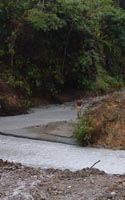
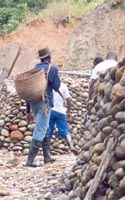
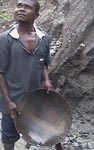
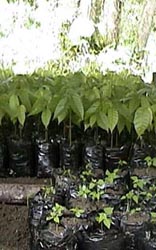
The work of the Community Council of the Alto San Juan is remarkable. It is an association that was formed by 30 villages in the Tado region of Chocol to represent their interest and preserve their way of life. It undertakes advocacy work at a regional and national level on land rights and mineral rights, a massive issue facing small-scale artisanal mining communities. They are often caught in the complex world of indigenous land rights, government owned mineral rights, foreign direct investments from multi national mining companies and opportunist illegal mining activities. These conflicts of interest if unregulated by a strong legislative system enforced by the authorities often lead to massive conflicts between the rights of small community groups and the vested interests of corporate companies. Needless to say it is the little people who generally lose. ASOCASAN has also developed an analogue forestry programme designed to improve the biodiversity of the eco system in the area, to improve food security, as well as reclaim the rainforest that has been destroyed by the legacy of large scale mining undertaken by western companies and the illegal mining operations. The devastation that is being caused by mechanised mining in the area is a big priority of ASOCASAN’s. They work tirelessly to promote small-scale sustainable mining practices that do not use acids, mercury, petro-chemicals or any other toxin that may cause long-term damage to the local eco system. Mercury poisoning to the waterways is a considerable problem, as affected water systems can take as long as 100 years to rectify themselves. To compound the problem the levels of deforestation that take place and topsoil degradation are profound and brutally destructive to the fragile nature of the forest. It is this mechanically mined and environmentally destructive gold and platinum that finds its way onto the finger of your loved one on your wedding day. What a token of our love for one another. Americo’s Mine Americo’s mine is a 1-hour drive deeper into the forest along rutted roads running parallel with the Rio San Juan the biggest in Chocó. At the end of our drive our arses are numb, the deodorant used that morning useless. Meeting Americo is like meeting a living ebony statue that Michael Angelo would have been proud of. He is in his mid forties and carved to perfection. A father of eight children he is clearly a busy man. He leads us over a 250-foot wide rickety old bridge, under which rushes the Rio San Juan 40 feet below. Striking out into the forest we are led through dense undergrowth, still and foreboding. We follow a number of forest streams flowing grey from the silt being pumped into them from mining operations further up river. Americo explains that this is only temporary, once the soil stops being washed these streams will return to crystal perfection. The ability of the local river courses to clean themselves so they do not become permanently silted is one of the ecological indicators that demonstrate that the local people are following sustainable mining practices. We walk in silence for 20 minutes, deeper into the forest with only the sound of whispering trees, chatting frogs and obnoxious birds to keep us entertained. As we climb up a small watercourse and turn a corner the ground opens up in front of us and we enter ancient history. Americo’s mine has been created out of the devastation of a large-scale mining operation some years earlier. It is like walking into a living sculpture. As the soil is washed and the large stones and boulders removed, instead of discarding them the miners begin to bank them up in perfect formation, creating large rock terraces similar to Aztec or Mayan design. Into this is placed topsoil for preservation, which will be used at a later date to start the analogue forestry programme. Above us is a dammed lake that provides the water for the soil washing and a home for a small alligator we are told. The water cascades down some 25 to 30 feet to the foot of mine, next to which 5 people are busy cleaning up the mess left by others. With a large hose powered by a pump one man sprays the soil at the base of what can only be described as a slagheap. This soil is washed into the river course that flows away over small wooden viaducts, which are designed to allow the soil to fall through the grills in the bottom, thereby catching almost 100% of the gold rich soil. There are about 3 of these wooden channels built into the river course, which are then emptied at the end of the day for manual panning. Americo can get about 20 grams of raw gold a day this way which is then sold to the not for profit marketing company Amichocó for refining and eventual marketing as Green Gold. 50% of the money from this goes to the labourers he hires, another 47% being split between him and his investor with the final 3% being given to ASOCASAN for community development and the analogue forestry work. With gold prices being a high as they have been over the last few years 80 to 100 grams of gold a week is a good income in this part of the world. Having witnessed the care, the beauty, the artistry, the culture in creation and harmony of this kind of small scale mining I despair of the motives of large scale mining companies who are captive to the free market dogma of increasing profits at the expense of life itself. In one week a mechanised mining operation can extract as much gold as one small-scale family operation can in 2 years. This money usually leaves the region or the country and ends up in shareholders pockets. It robs the majority of a sustainable income and displays the worst possible attitude towards their culture and home by leaving these sites a barren wastelands for someone else to clean up. Americo and his workers display integrity and a care for their home and environment that allows me to breathe hope for the future. I imagine coming back in ten years time with the forest having completely reclaimed this land, complimented by Americo’s sculpted mine and wonder whether I have discovered the ancient secrets of South American culture; harmony with life.
Before leaving the Chocó, we visit The Environmental Research Institute of the Pacific. This is an organisation consisting of Government, Universities, the local councils of black communities and the councils of indigenous people. It main job is to research and promote environmental sustainability in this part of the world. It also acts as the independent certifying body for the sustainable mining practices that Americo and the other 100 small-scale mining operations in the Chocó region work with. The certifying body is always independent of the community associations and other NGO’s that are involved in the process, thereby maintaining the independence of the certificates that are issued to green gold products and removing any form of conflict of interest that may arise. I questioned how a government body could be seen as independent, however the groups involved in its management are all executive in power with voting rights of which the Ministry of the Environment has a minority vote in all decisions that are taken. IIAP have developed a sophisticated means of determining a healthy eco-system through a process of identifying bio-indictors that can be taught to the local people and also act as the main criteria for establishing whether a mine is practicing sustainability. The small beetle (deltochilum gibbosum) indicates a good quality soil. I am told that with beetles IIAP are looking for quantity and diversity of species. The more and diverse they are the better the quality of the soil and surrounding eco-system. Whereas the worm (ordew haplotaxia) means that the water quality in the area is very poor. The certifiers spend most of their time in the forest with the miners collecting the bio-indicators from wildlife and plant life and teaching the miners to do this job themselves. It’s a great job and is having a phenomenal impact on preserving and improving the environment for local people in this part of the world. This process is vital to the whole supply chain. For me it means as we design and develop our wedding collection, all our collection will be independently certified as coming from a clean mine. This guarantees that the product the customer buys is definitely pure 100% non-exploitative gold.
The Green Gold Corporation as a registered non-profit organisation is comprised of 4 other NGO’s and community councils. COV bring them all together under one banner in order to facilitate better communication between the different groups, develop an integrated model that benefits the local communities, allows the local communities to have a closer relationship with the marketing of their gold and to assist in raising finance for all the different actors involved with the mining and reforestation work. It is the acumen behind the process of extracting and marketing ecologically mined gold. Catalina and Nicolas Duque Cock are brother and sister whose genius and energy created the framework for the whole green gold operation to come to birth. They saw the destruction that illegal and large scale mining was having on their country and as committed environmentalist felt the urgency to respond to the crisis in a way that was empowering for the local communities, as well as preserving the integrity of the traditional ways of life in Chocó and its unique environment. Their approach is rooted in a blend of radicalism and pragmatism. “Its no use doing all the work on empowering local communities and preserving the environment if we cannot develop a market for the gold that our friends are mining. If they do not make a living out of the process the illegal miners will offer cash incentives to the communities for permissions to destroy their environment by mining their gold” says Catalina, who at 28 has achieved much since graduating with an MA from London School of Economics in ‘social policy and planning for developing countries’. It is COV who has really ploughed a lonely furrow on environmental small scale mining, arguing that legalising and empowering small scale mining communities can have huge long term benefit for the local eco-system, long term job security, the health and education infrastructure of remote communities as well as bringing much needed tax revenues to the national exchequer. This argument is not rooted in an economic philosophy or a social policy theory but is rooted in reality. COV have proved it in Columbia. Their approach works and is better than the religious dogma of Foreign Direct Investment (encouraged by the WTO, World Bank and IMF) that creates the climate for multi national corporate mining companies to exploit a resource that is not theirs and move the profits to a London stock market. The trade off being they pay foreign currency to the national exchequer that goes towards increasing export activity, falsely inflating GDP figures that then contributes to the financing of the countries international debt. The only winners in this kind of world are the minority of people associated with the mining company. It is exactly this kind of fiscal farce that is behind every form of environmental exploitation on the planet. It is time we used alternative ways to create wealth, prosperity and sustainable progress. Refining the Gold Back in Medellin I visit the gold refinery that COV use to turn the raw gold into the refined gold that will make my wedding collection. Chemistry was never a subject I paid much attention to at school. If as schoolboys we had spent our time refining gold I would have had a greater incentive to pay attention. The refining process is perhaps the most boring part of my journey. A warehouse full of acrid smells, boiling cauldrons, garish coloured liquid chemicals in glass jars. It is somewhat reminiscent of a modern day alchemist’s lab from a Hammer Horror B movie. The raw gold is placed in a mixed solution of Hydrochloric Acid and Hydrogen Peroxide (the stuff I use to bleach my hair with as a teenager). COV use this refinery because they use Hydrogen Peroxide instead of Nitric Acid, a far more damaging and dangerous chemical. The gold dissolves into a liquid, the noxious gases generated are trapped in a series of flues in a tall gas chamber where they are separated and absorbed by caustic soda before being disposed of safely. The gold solution is then boiled with sodium bisulphate, the end product being pure gold. Refining gold has to be done chemically, which is not in keeping with the spirit of the pure wedding ring I am searching for, however there is no other way of removing the impurities present in the gold. So COV have chosen to work with Senor Gutierrez, as he is the only refiner in Medellin that is prepared to minimise the chemicals used to refine the gold and his environmental waste management is the strongest. As he said to me “it pays to be diligent in how we dispose of our waste, everything we throw away contains a precious metal and precious money.”
Jailo Sierra - The Jeweller So at last I have in my hand refined gold that I can use to create our wedding collection. However I now need a jeweller who can turn the gold into the finished product. Jailo Sierra has been a jeweller for 30 years. He lives with his wife in Medellin. He runs a small operation having rejected a larger scale jewellery workshop since he was burgled and lost everything. He wants to focus on creating not becoming rich. This I think is a jeweller who shares the same ethic as myself. He has worked with COV for a number of years and passionately believes in preserving the traditional art form as much as possible. His wife is descended from the pre Columbian Sinu culture who were renowned for being the finest goldsmiths in all of northern South America. We talk at length about weights, dimensions, and the finish of the metal, thickness, feel and much more. He loves the idea of using the green gold for the wedding collection. “Pure gold for an expression of a pure love” he comments. When I went into the jewellery business I naively thought I would make a living from selling quality jewellery to the customer and hopefully give some of my profits to health and education projects in other parts of the world. I never conceptualised for a minute that the demand created by the selling of jewellery was complicit in; unjust terms of trade between rich and poor nations, complex and secretive political relationships with multi national companies and was having a devastating impact on the environment indigenous communities were living in. It has radicalised me to do jewellery differently. Click here to view Cred Jewellery Wedding Rings >> The complete Collection will be available at The Natural Store by the end of July 2006 |
||||||||||||||||||||||||||||