 |
| 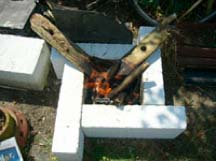 |
| Obtaining the essential ingredient of wood ash water |
|
To Dye and What With? That is the Question.
Better Thinking tell us of their experiments in the kitchen with environmentally sound dyes and mordants from the likes of boiled rhubarb leaves and rusty nails!
Despite some very busy paid projects happening in the studio at the moment, we’ve had the help of a lovely intern to ensure our perfect t-shirt project maintains momentum. Sarah Murphy, a fashion student at Central St Martin's, has been on the case, filling in gaps of our knowledge all over the place, from supply chains to packaging to production methods. However, the main thing she’s been focusing on has been experimenting with environmentally sound dyes: after last month’s heavy-duty report on the subject we decided to put some of our learnings to the test and see whether our preferred colouring methods live up to their promises. The results have been really exciting although not quite what we expected: something we hoped would turn out black came out a lovely chocolatey brown colour instead. We were really pleased with this but in order for the shirt to appeal to those with more classic taste, we do need to continue our quest so we can offer one in black. We’ve got a few tricks up our sleeve to make the colour darker. We were also a little shocked to hear how long it would take to test our preferred dyeing method: unlike conventional garments which finish their dyeing process in a number of hours, we need to leave our samples for 4-6 weeks before they’re ready for their first trial washing.
 |
|
| Sarah Murphy, Better Thinking's new intern, gets to the bottom of the eco-dying issue |
|
|
It’s been great hearing the stories of what Sarah’s been up to in her dye-experimenting laboratory at home, she’s been testing out natural scouring solutions such as wood ash water, and mordants of wine, vinegar, one made from boiled rhubarb leaves and another that’s the result of water, vinegar and rusty nails left in a bucket for a week. It’s really hard to find out precisely what the environmental effects of each of these are, but we know they’re all better than conventional practice. If any of them work well, we’ll be taking another step in filling another piece of the puzzle.
| 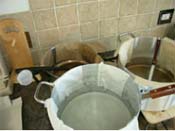 |
| Part of the Experimenting Area |
|
You can read about the progress of the experiments, download the full 24-page dye report and get involved with the project at http://www.betterthinking.co.uk/perfect
|
 Back to e-zine


