Back to e-zine
|
|||||||||||||||||||||||||||||
 |
I guess you can say that I was almost born with a concern for the environment. Whether it was a reaction against the excesses of the eighties that I witnessed as a child, or the empowering feeling one gets while 'doing good’, I certainly have green blood flowing in my veins. I even used to tell my mum to close the tapwater while she was brushing her teeth (I was 4!). The real and tangible commitment, though, came about 3 years ago. Professionally, I’d been a graphic design (often working with non-ethical corporations) for almost 8 years. I felt like my personal and my professional life were split asunder and definitely not aligned. At that point, being 31 and feeling like I should really take a stand and walk the walk, I started making major changes in my life. The first thing I did was to quit the cushy job I had in an ad agency. With the clients I had there was no way I could ever even dream of being ethically aligned. So I went back home, designed my working space and started trying to find clients. At first of course, I took any client I could get, which were not always completely 'green', but they were better than the ones I had been creating for at my previous job. In my spare time I voraciously read everything there was to read about sustainable development and eco-design. At length, I identified two huge sources of pollution: fabric and plastic shopping bags found in landfills. I then stored all this information up for later use.
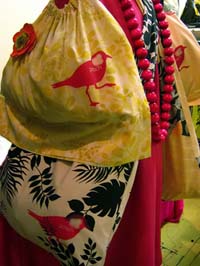
In the winter of 2005 I randomly decided to take a vacation in Thailand and there I had a revelation. In a small town called Pai, I had coffee with friends in a small café called 'All about Coffee' where they had, amongst other lovely ethical gifts, some bags that were made from recycled cotton clothes. Suddenly, the plastic bags and fabric figures popped right back in to my mind. I had already been annoyed for months with the ubiquitous, made-in-China, beige canvas shopping bags that the big grocery chains were selling like hot cakes. Being style conscious, I always refused to buy them, instead carrying my much better looking totes around with me. The colourful simplicity and low cost of the 'All about Coffee' bags inspired me to try and design a recycled eco-chic reusable shopping bag, that would be a stylish and durable alternative to the beige shopping bags. I felt passionately enough and believed I could do even though I was not an accessories designer nor had any experience in marketing a product, let alone trying to produce one.
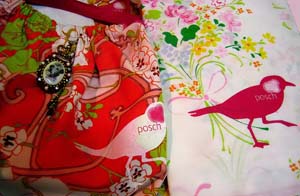
Upon my return to the bitter cold Montreal winter I met with a crafty friend and together (after visiting several thrift stores) we came up with the idea of using vintage bedsheets as our main material. The idea being that its always possible to re-wear clothes but bedsheets, and other used fabric, often end up in landfills intead of being reused. We then researched all kinds of models that would not waste fabric. In the beginning we also wanted to make them completely foldable in a tiny pocket but we soon found that production costs would skyrocket and we wanted to keep the product simple and very affordable. At this point, it felt like all aspects of the concept were beginning to take shape. I knew I wanted to give a certain amount of the profits to my favorite local NGO and also that I wanted people to directly associate the bags with nature. Whilst doing some research on endangered species in Quebec (my native province) I became aware that there were only 500 piping plovers left and that they were going fast. In case you have never seen them, piping plovers are the cutest, most alert little beach birds you can ever dream of observing. They have tiny little legs, a funny egg shaped body and oversized pointy beak, and they run to and from the waves by the ocean, endlessly. To me, they epitomise summer holidays and my eyes welled up when I read that they are endangered and on the vege of extinction. I also learned that their coastal habitat has been made fragile, mostly by climate change being induced, in large part, by human pollution and landfills overflowing with, namely, fabric and plastic bags. The loop was closed and the concept, locked in. We would use the piping plovers in our designs as the encapsulation of nature. That night, we drank champagne to celebrate!
Eight months after starting the project, I can safely say that its the most exhilarating ride of my life! I’m getting press, I’m in Paris as you read this at the Ethical Fashion Show (please come along to see us) and I now have the privilege to sell the bags through The Natural Store. I feel truly blessed and happy that I took the bull by the horns and didn’t let it go (yet…). I hope that if you decide to purchase a POSCH bag that it will bring you luck and help eliminate the use and discarding of hundreds of plastic bags worldwide every year. And of course, you’ll look great while doing your shopping! Click here to view the POSCH collection >> “ 80-90% of the total lifecycle costs of any product (environmental and economic) are determined by the product design before production even begins.” Ezio Manzini, leading thinker in Sustainable Design. Facts About Plastic Bags - Each year, an estimated 500 billion to 1 trillion plastic bags are consumed worldwide. That comes out to over one million per minute. Billions end up as litter each year. - 1.4 billion: the number of plastic bags Quebecers use every year. - The SGE (Société de Gestion Environnementale in the province of Quebec) estimates that every household uses about 10 plastic bags per week or 520 bags per year. - Plastic bags take 400 years to break down, cause visual pollution and can kill birds or fish that ingest them. - Plastic bags don’t biodegrade, they photodegrade—breaking down into smaller and smaller toxic bits contaminating soil and waterways. - Plastic bags are among the 12 items of debris most often found in coastal cleanups, according to the nonprofit Centre for Marine Conservation. |
||||||||||||||||||||||||||||