Back to e-zine
|
|||||||||||||||||||||||||||||
 |
Ethiscore is an online version of the ethical shopping reports that have been the backbone of Ethical Consumer magazine for the last 17 years. From its humble beginnings in a council flat in Hulme, Manchester the magazine has succeeded in informing and empowering a growing ethical consumer movement. Our database contains information on the behaviour of over 30,000 companies. It holds data on companies from anywhere in the world - from small independents to large multinationals in five main areas: environmental (things like nuclear power and climate change), people (human rights for example), animal welfare, politics (things like political donations and boycott campaigns) and product sustainability (any organic or fairtrade products).
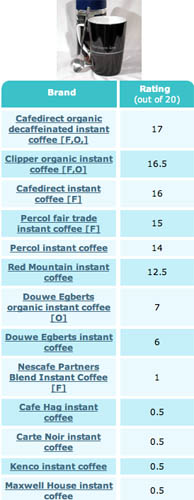
Ethiscore (www.ethiscore.org) was launched one year ago, and helps users quickly and easily identify the best products to support and the worst companies to avoid. It does this by calculating an 'ethical score' out of 20 for a wide range of consumer products and services. Roughly speaking: *15 to 20 is good, *10 to 14 is average, *5 to 9 is poor, *0 to 4 is very poor. The Body Shop, trailblazer of ethical issues on the high street, saw its ethical rating fall from 11 out of 20 to 2.5 on "Ethiscore", when it was taken over by cosmetics giant L'Oreal. L'Oreal receives a worst rating from Ethical Consumer for its animal testing policy, and also has had boycott calls against it for testing its cosmetic products on animals. And while the Body Shop has always considered natural ingredients as important, L'Oreal is criticised by environmental campaigners for including harmful pollutants and worrying chemicals in its cosmetics. L'Oreal's link to Nestlé - it owns 26% of the company - was also a factor. Nestlé is the subject of a long-running boycott because of its marketing of breast milk substitutes. The great thing about Ethiscore is that it reflected the take-over immediately, and suggests ethical alternatives to consumers.
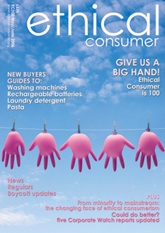
There has been a sea-change in public understanding of the damaging behaviours of big business; and surveys around the world are showing very widespread interest in ethical consumer issues and projection of dominant ethical markets are beginning to come from the least expected places. The Co-op Bank publish an annual measurement of the state of the UK’s ethical markets performed by the Co-op Bank’s Ethical Purchasing Index. It shows £25.8 billion of ethically directed money (up from £9.2 billion in 1999). In November 2005, for example, a spokesperson from Kraft General Foods (the world’s second largest food Multinational) predicted that within 10 years, 60-80% of the market for coffee would be taken up by products with independent certification for fair trade issues. Ethical Consumer has played its part for seventeen years now in developing a culture of opposition to an economic orthodoxy which is clearly now in retreat. Our 100th issue is in the shops now, and we celebrated this milestone with a big party in Hulme. We plan to be here for issue 200 in 2023.
The bigger and more influential we have become though, the more controversy we have become embroiled in. Before we published the clothing report “Cottoning On” in February 2006, we made an experimental arrangement with the Independent newspaper which allowed them to publish an exclusive Ethiscore table based on the forthcoming report. On December 8th the newspaper gave a full page to the story under the headline “Primark is named least ethical clothes shop.” The story seemed to strike a cord because, following its publication, around 30 broadcasters and 20 national publishers were in contact to explore their own stories on the piece. Unsurprisingly perhaps, a number of companies including Primark, also contacted us with a view to discussing the rating system. The corporate approaches meant that we asked our printers to delay printing until outstanding issues were resolved.
Primark, who had not responded to our original requests for information on issues like supply chain codes of conduct, rectified the position. Within days its supplier code - which with named independent monitors received our best rating - appeared on the company website. Marks and Spencer also changed its company policy to publicly disclose the names of their supply chain monitors for the first time, and to undertake a phase-out date for PVC in order to receive a better rating in the report.
We plan to develop the campaigning potential of Ethiscore in the next year. The site currently allows users to email companies directly from the report, and tell them you like its ethics or you don't like its ethics. We are branching out into co-ordinating a campaign focusing on workers’ rights in the garment industry. Many people ask us what difference they can make when up against multinational companies. In the controversial clothing retailers report, we found that a number of companies hadn’t even set out the most basic measures for protecting workers in their supply chains. Codes of Conduct for workers’ rights at supplier companies set out standards which must be adhered to. These commonly include provisions on child and forced labour, collective bargaining, living wages and discrimination. They should ideally be based on the International Labour Organisation core conventions, or the Ethical Trading Initiative base code. We are going to be targeting the slackers, and you can get involved at www.ethiscore.org You can purchase The Ethical Consumer from The Natural Store. Click here to go to The Ethical Consumer Magazine >> |
||||||||||||||||||||||||||||