Back to e-zine
|
|||||||||||||||||||||||||||||
 |
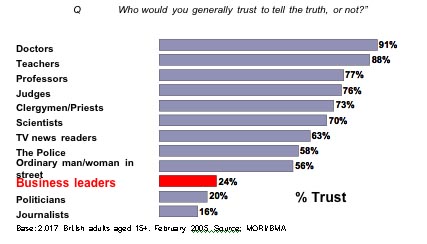
People might consider ethical business an oxymoron, and the idea of multinationals making an honest profit as impossible. Surveys of public opinion continue to show that the general public holds business in rather poor repute. There are positive signs that big business is increasing its interest and commitment to ethical values. Eighteen years ago only 18% of larger companies had published codes of ethics. Today 90 per cent of the FTSE100 have ethics policies in place. The socially responsible investment movement has grown considerably as pension fund trustees are required by law to consider ethical issues and the ethical indices like FTSE4Good have been launched. Of course there have also been the negative drivers pushing corporate ethics into the spotlight. Bad business behaviour has become headline news with the environmental and safety scandals such as Exxon-Valdez, Chernobyl, Bhopal, Shell and Brent Spar in the '80s and financial scandals including Enron, WorldCom and Barings Bank in the '90s. Human rights and supply chain issues involving global brands like Nike and Gap have also hit the headlines in the last few years. As many of the scandals involved senior staff, corporate responsibility is being taken more seriously in boardrooms. As the media and public are now more aware of business ethics issues, organisations need to continue to scrutinise all aspects of how they operate: from their relationships with their suppliers to encouraging diversity amongst their workforce to how their business interacts with government through political donations and lobbying.
Businesses need to be proactive in order to protect their reputations. What ever your business, doing business ethically, as well as being seen to do ethical things, makes good business sense, as well as being the right thing to do. Whether you sell tobacco or organic face cream, the issues have become far more complex because of the increasingly cross cultural nature of business activity. It is risky to leave the resolution of business dilemmas to the moral consciousness of diverse individual employees. Managers have a responsibility to lead, guide and support staff to do the right thing. Since its launch in 1986, the Institute of Business Ethics has played a key role in helping companies to see that doing business ethically makes sense. A registered charity, it was created by business people for business people to encourage high standards of corporate behaviour and the sharing of good practice. We support companies and other organisations in the development, implementation and embedding of their ethics policies and practices. Our challenge is to help companies realise that in order for their ethics policies to be effective, they need to embed their values deep within the organisation’s “DNA”. It is not enough to simply draw up a code and file it. It needs to be translated into reality through training and enforcement and should be driven from the top. When it comes to ethics, directors really do have to walk the talk. Click here to go to the Institute of Business Ethics >> |
||||||||||||||||||||||||||||